Showing posts with label Way Back When-sday. Show all posts

Wednesday, January 8, 2014

Way Back When-sday: 1927

I'm deep in research for my next novel. It's set in the summer of 1927 and I'm having a blast learning more about this dynamic decade.

The word that best describe the 1920's to me is change. After World War I, society changed overnight. The confines of culture fell away and freedom reigned. Women cut off their hair, shortened their dresses, and took off their corsets. Electrical appliance transformed the domestic life and lightened the load on the house wife. Hollywood began to transform the nation through motion pictures. Technology made it possible to spread news across the globe in a matter of minutes. Continents were connected through aviation. And women finally had the right to vote.


Ironically, in this time of freedom and relief from the confines of societal pressures, prohibition held fast. But the very law that made alcohol illegal, also made crime and corruption rampant.

As I research our local daily newspaper in the summer of 1927, many interesting tidbits of life jump out at me.

1. Aviation Ruled. On May 21st, 1927, a small airplane, carrying a young, unknown man from Minnesota, landed in Le Bourget, France, just 33 1/2 hours after it left New York. Charles A. Lindbergh instantly became the most famous man in the world. Six men died attempting the same flight in the weeks before Lindbergh successfully flew the Atlantic. The world held its breath until he landed safely, and then he became the first Super Star in history. The cameras loved this handsome Midwesterner. He captivated the world with his good looks and his daring accomplishment.

But one town on the planet was especially proud:. Little Falls, Minnesota, Lindy's hometown.

Photo courtesy of the Morrison County Historical Society
The reason I'm doing this research is because Little Falls is also my hometown, and my next story is set here in the summer of '27. Our little, inconspicuous town was now talked about in the New York Times and known around the world. Can you imagine?

He came home in August of 1927 on his Goodwill Tour. Between July 1927 and October 1927 he flew to all 48 states in the Union, and it's estimated that 1 in every 4 Americans went out to see him on the tour. Our town put on quite a celebration in honor of Lindbergh! And that's where I'm placing my hero and heroine--right in the midst of it all.

Every day, without fail, our local newspaper covered an aviation story. After Lindbergh made his trans-Atlantic flight, others followed in his footsteps. Flights were made from California to Hawaii, New York to Paris, across the United States, and on and on. One editor put it quite well:

Photo courtesy of the Morrison County Historical Society
2. Beauty Pageants Enthralled. One of the other interesting items I'm noticing in the newspaper is the sheer volume of beauty pageants and contests held in the 1920s. The daily paper has pictures of women from all across the US winning different pageants and contests. It's an interesting cultural element that I'll be studying more.


3. Hollywood Influenced. I'm amazed at how much the daily newspaper mentioned Hollywood--and not all of it was good. One of the main themes I've noticed, especially in the editorial pieces, is the influence Hollywood had on divorce. It seems that one divorce or another is mentioned almost every day. The editor makes many comments on how flippant actors and actresses were about marriage. It seems some things never change...

Photo courtesy of the Morrison
County Historical Society
Many other fun things were going on in the summer of 1927. President Coolidge was visiting the Black Hill of South Dakota, a young maid in a wealthy mansion in Canada fell in love with the heir and was having a grand wedding in the "wilderness," women were beginning to challenge the protocol for courting (by pursuing men!), and motoring on the weekends was becoming a popular past time.

1927 is a fun year to research and I can't wait to weave this information into the fabric of my story.

Your Turn: What word would you use to describe the 1920s? What intrigues you about this decade?

Tuesday, November 19, 2013

Way Back When-sday: The History of Television

I'm constantly amazed at the advancement in technology. The concept of the television was first sketched in 1878, shortly after telephones were invented. At the same time, science fiction authors imagined that light could be transferred over copper lines, much like sound was.
 
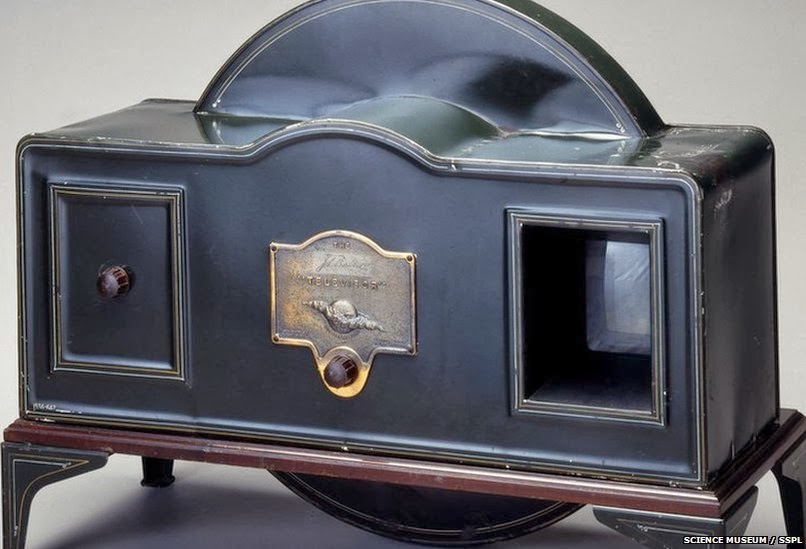
Over the next fifty years, numerous scientists developed the idea and great advances were made. In the early 1930s, John Logie Baird produced about a thousand television sets in the United Kingdom called the "Televisor." The 1936 Olympic Games in Berlin were carried by cable to television stations in Berlin and Leipzig for the public to view live. In 1939 RCA brought the television to the general public at the World's Fair in New York, but with the outbreak of WWII, mass production was stalled. It wasn't until after the war that televisions began to grow in popularity in American households.
 
Here are a few pictures documenting the change in televisions from 1930 to 2013.


One of the earliest television sets, introduced in the UK
The Baird "Televisor" - 1930-1933
 
RCA introduced this television at the 1939 World's Fair in New York
Early 1940's Television Set

The television became popular after WWII
when they became mass produced.
This is a late 1940's model.
 
1950's
The first national color broadcast took place
on January 1, 1954 - the Tournament of Roses Parade

1960's
In 1965, half of the networks switched to color, which boosted
sales of color televisions

1970's
In 1972, the last of the national networks switched
to color and sales of color televisions surpassed black & white

1980's

1990's
 
2000's
2013

Your Turn: Did you ever own a black & white television? Which of these models do you remember from your childhood?


Tuesday, November 12, 2013

Women in Early Aviation

My next story will be set in 1917, as America enters WWI. At this time in history, flight was a fairly new phenomenon.

My heroine is captivated by airplanes. In central Minnesota, where she lives, she has only seen one airplane in her life. When a Curtiss JN-3 (bi-plane) flies overhead and lands in a nearby field, she will do whatever it takes to get a ride in the air...and eventually she convinces the handsome pilot to teach her how to fly.

1916 Curtiss JN-3 Bi-Plane
In my research, I've discovered some amazing women who pioneered aviation. I thought I'd share just two of these women, but I'm including a fun link to the Smithsonian's Air and Space Museum, where you can learn more.

NASM-81-3423
National Air and Space Museum Archives, Smithsonian Institution
The Baroness Raymonde de le Roche was the first woman in the world to receive her pilot's license. She learned to fly a plane in 1909, just three years after the plane was invented! She lived in France and won a competition for a 4 hour non-stop flight, as well as set a record for altitude in 1919. Sadly, the same year, she was attempting to be the first female test pilot for a new type of aircraft and crashed to her death. There is now a statue of her at the airport in Le Bourget, France (which I visited in 2010).

NASM-2002-23705
National Air and Space Museum Archives, Smithsonian Institution
Harriet Quimby was the first woman in the United States to receive her pilot's license, in 1911. Harriet went on to be the first woman to fly across the English Channel. Her advisor wasn't sure a woman could accomplish the task, so volunteered to dress like her and complete the feat in her name--but she refused him. In 1912, Harriet was flying in the Harvard-Boston Aviation Meet and was tossed from her plane, to her death. Ironically, the plane glided to a perfect landing.

Sadly, both of these early aviators died pursuing their passion, but many more lived to tell amazing tales about their flying days. I encourage you to stop by the Air and Space site to discover more. You can find that link here.

Your Turn: Would you be brave enough to fly an airplane only three years after it was invented?

Wednesday, August 14, 2013

Gowns From 1800 to 2013

I've love using Pinterest as a way to collect pictures of clothing for my characters. My first story was set in 1857 and my second was set in 1898, but I've been gathering images from numerous eras.

I thought it would be fun to watch the amazing transformation women's gowns have taken from 1800 to 2013.

It was interesting for me to find that somewhere around 1930 designers started modifying designs from previous generations and "updating" them. The trend has continued to this day. Since 2000 it's hard to determine what the "style" has been. It's such a combination of many eras.

I was also surprised to find that some gowns were only slightly modified from one decade to another, but there are a few decades that changed drastically (such as the 1910s to 1920s).

Here are some of my favorite gowns from the past two hundred years.

c. 1800
c. 1810

c. 1820

c. 1830
c. 1840

c. 1850
 
c. 1860
c. 1870

c. 1880

c. 1890

c. 1900
c. 1910

c. 1920

c. 1930
c. 1940
c. 1950

c. 1960
c. 1970

c. 1980

c. 1990
c. 2000

c. 2010
Your Turn: What is your favorite era? If you could choose, which gown would you bring back?

Wednesday, August 7, 2013

Famous Minnesota Picture

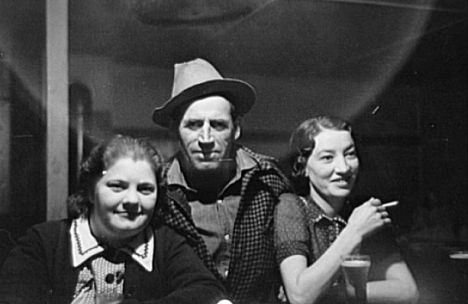
"Saturday Night in a Saloon"
Picture Courtesy of Library of Congress
Recently I was doing some research and I came across this famous Minnesota picture. I knew it was taken in Minnesota, but I didn't know much about it...so I had to investigate further. It was taken in 1937 in Craigville, Minnesota in Koochiching County by Russell Lee.

Can you place it?

This iconic picture was used in the opening credits for the television show Cheers. A seemingly lighthearted photograph, this picture actually reveals a great deal about a town in Northern Minnesota that wasn't so idyllic.


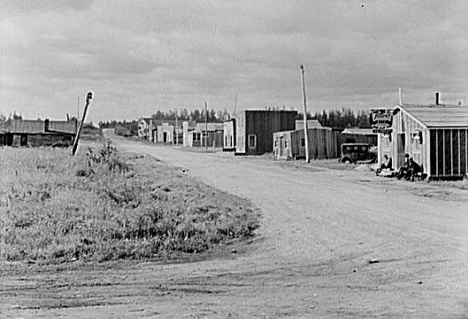
Main street. Craigville, Minnesota, 1937
Main Street, Craigville, Minnesota 1937
Picture Courtesy of Library of Congress

Upon further research, I discovered this picture of Main Street in Craigville, Minnesota in 1937. It wasn't much. Most of the buildings weren't even finished. Logging was its main industry until 1952. During the logging season anywhere between 5,000-7,000 loggers would come into town.


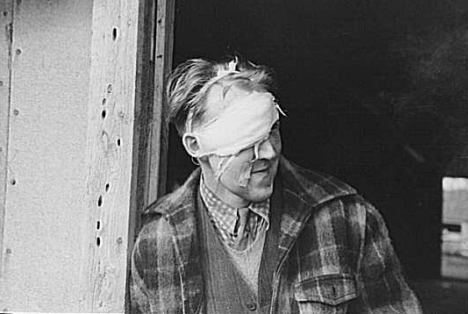
Lumberjack with bandaged head after being beaten up and "rolled" in a saloon on Saturday night in Craigsville Minnesota, 1937
A lumberjack after a brawl in a saloon on Saturday night.
Picture Courtesy of Library of Congress
 
With the influx of loggers (and their hard earned money), the town was filled with all sorts of criminal activity. Prostitution, murder, theft and bootlegging--to name a few. It was so bad, no one could do anything about it. The town had a terrible reputation, not only in Minnesota, but across the USA.
 
Lumberjack and two "attendants" in saloon of Craigsville Minnesota, 1937
A lumberjack with two "attendants."
Picture Courtesy of Library of Congress
 
In 1937, photographer Russell Lee visited Craigville and documented the "seedy" lifestyle of the loggers, prostitutes, bootleggers and business owners. If you look closely, this man and his two "attendants" are the same people in the "Saturday Night in a Saloon" picture.
 
Researching can be an interesting adventure. You never know what you're going to unearth. Some of the stories I read about Craigville made me cringe. It was a dangerous town. I wanted to cry when I read about the prostitutes who inhabited the rough buildings. I always wonder what would lead a woman into such a sad choice. I don't think I'll ever look at this picture the same way.
 
Craigville is now a ghost town in Northern Minnesota. Some buildings remain, but they're falling apart and overgrown with weeds. The town that brought so much pain, to so many people, is now decaying in the Koochiching Forest.
Photographer Russell Lee

Russell Lee was an American photographer, best known for his work for the Farm Security Administration. He traveled around the United States between 1936 and 1943 documenting various American classes and cultures. Apparently he heard about the notorious town of Cragiville, Minnesota. Many of his photos are in the Library of Congress.

I wonder if Russell Lee had any idea how famous his "Saturday Night in a Saloon" photo would become?

In the words of Paul Harvey: "And now you know the rest of the story."

Have you seen the photo "Saturday Night in a Saloon" before? Did you have any idea what the real story was behind it?

Wednesday, July 31, 2013

Way Back When-sday: My ACFW Outfit

This year, during the Friday night dinner at the ACFW Conference, attendees are invited to dress up in the genre, character, or era they write. When I saw this invitation, I immediately knew what I wanted to wear.

A few years ago I had the pleasure of portraying Evangeline Lindbergh (Charles Lindbergh's mother) during Living History Days at the Charles A. Lindbergh Historic Site where I worked. During Living History Days we interpreted the year 1917, which is the year my next novel, Enchanting Lydia Walker, will be set.

With a few emails, I was able to locate the costume I wore for that event and I'm hopeful I can wear it for the ACFW dinner. Part of the costume will be sent to me from Kansas City (thank you, Mary!).

Below are a few pictures I pulled together to show you a typical outfit an Edwardian woman would have worn for everyday wear.

This blouse is similar to the one I wore for the Living History Day.
I'm amazed at how light and airy the blouses are.

This skirt is similar to the one I wore.

I didn't wear a corset (I couldn't find one!),
but if I did, this is what it would look like.
The Edwardian woman was praised for her
"S" shaped silhouette.
Complicated Edwardian hair
I love this hairstyle! Miss Lily Elsie was one of the most
photographed Edwardian women. I've discovered many
pictures of her hairstyles. I hope I can do this with my hair!
It will take lots of practice.

This is the only picture I have of the Living History Day.
This is the outfit I hope to wear (minus the shawl). I was
three months pregnant in this picture. :)

Your Turn! If you're going to the ACFW Conference, will you dress up on Friday night? If so, what will you wear? If you're not going, what era would you like to portray?